Benchmarks
The benchmark suite is now focused on the two ensemble families that matter most for ForestFire’s current positioning:
- random forest
- gradient boosting
It intentionally no longer centers extra-trees-specific comparisons or the older one-off inference plots.
All active benchmark families use 1000 trees or boosting stages by default.
That tree-count budget is held equal across libraries, while the per-cell leaf
budget is still matched from the realized ForestFire model.
What is benchmarked
The suite currently measures:
- training time
- prediction time
- training micro-phases
- prediction micro-phases
make_moonsprobability surfaces for classifier ensembles- one-dimensional regression prediction curves for regressor ensembles
For prediction, the suite also includes:
- base ForestFire models
- all-core
optimize_inference()ForestFire models
That means the prediction grid is designed to show both:
- how the semantic model behaves directly
- how much the optimized runtime changes the picture once row counts get large
Libraries compared
Depending on the family, the benchmark scripts compare against:
- ForestFire
- ForestFire optimized inference
- scikit-learn
- LightGBM
- XGBoost
- CatBoost
Important qualifications:
- CatBoost is included for gradient boosting
- CatBoost does not expose a direct random-forest benchmark mode, so the RF grid records it as unsupported there rather than pretending there is a like-for-like RF comparison
- the prediction benchmark still uses the same backend set
- but each backend is trained once per feature-count cell, after which only prediction is timed across the row grid
Dataset design
The benchmark datasets are intentionally learnable.
They are not random-label or pure-noise benchmarks.
Each dataset includes:
- threshold structure
- interactions
- linear signal
- nonlinear signal
- extra noisy features
That matters because the point of these benchmarks is not just to stress parsers or tree allocators. It is to measure the cost of training and serving models that have real structure to discover.
Benchmark grid
The benchmark scripts run over:
- rows:
2^13,2^15,2^17,2^19 - columns:
8,16,32,64,128,256
These are logarithmic grids:
- rows on powers of 2 with exponent steps of 2
- columns on powers of 2
The purpose of the grid is to separate two different scaling questions:
- what happens as dataset length grows?
- what happens as search width grows?
Those are not the same pressure on a tree system.
Micro-benchmarks
The grid benchmarks answer end-to-end questions.
The micro-benchmarks answer a different question:
- where is ForestFire itself spending the time?
They are ForestFire-only by design. They do not compare against other libraries, because the point is to isolate ForestFire’s own bottlenecks rather than library-to-library competitiveness.
Training micro-benchmark
The training micro-benchmark splits the fit path into three phases:
table_buildfit_from_tablefit_end_to_end
What those mean:
table_build: training-side preprocessing onlyfit_from_table: learner fit on an already-builtTablefit_end_to_end: the full publictrain(X, y, ...)path
This lets you see how much of total training time is being spent in:
- input normalization
- binning / sparse-vs-dense table construction
- the learner itself
The training micro-benchmark still runs over a row/feature grid, but it uses a smaller default row range than the macro benchmark so fixed preprocessing overheads remain visible.
Prediction micro-benchmark
The prediction micro-benchmark fixes training complexity and varies only prediction batch size.
That separation is important, because otherwise a prediction benchmark is partly a training benchmark in disguise: changing the row count also changes the realized model.
The prediction micro-benchmark therefore:
- trains one reference model at a fixed training row budget
- lowers it to an optimized runtime once
- serializes / reloads the compiled optimized artifact once
- benchmarks only the runtime prediction paths on varying batch sizes
The prediction phases are:
predict_basepredict_optimizedpredict_compiled
What those mean:
predict_base: semanticModel.predict(...)predict_optimized: loweredOptimizedModel.predict(...)predict_compiled: deserialized compiled-artifact runtime
That makes it easier to answer questions like:
- is the optimized runtime faster once training complexity is held constant?
- how much of the benefit survives compiled-artifact reload?
- at what batch size does the optimized runtime start pulling away?
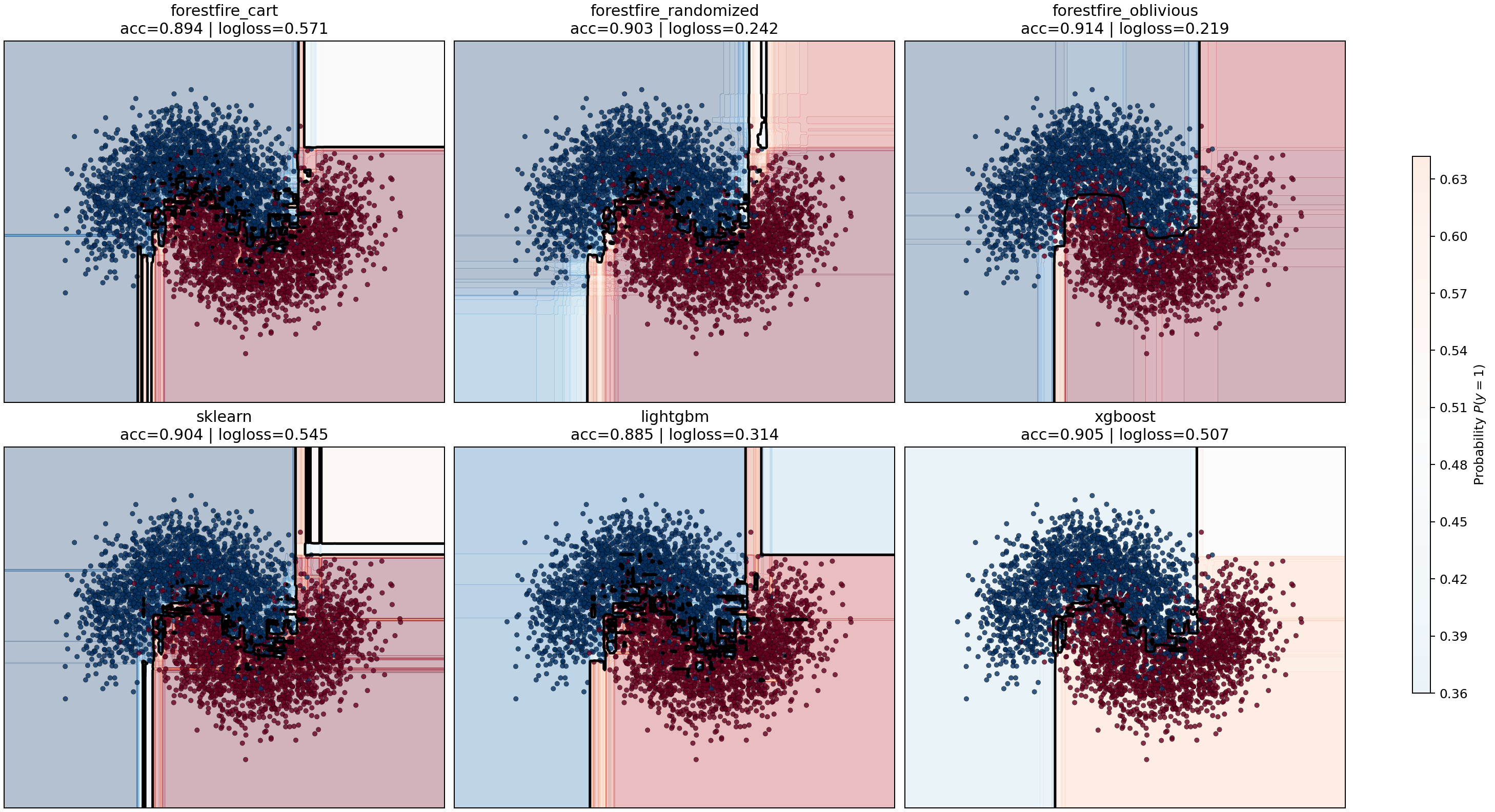
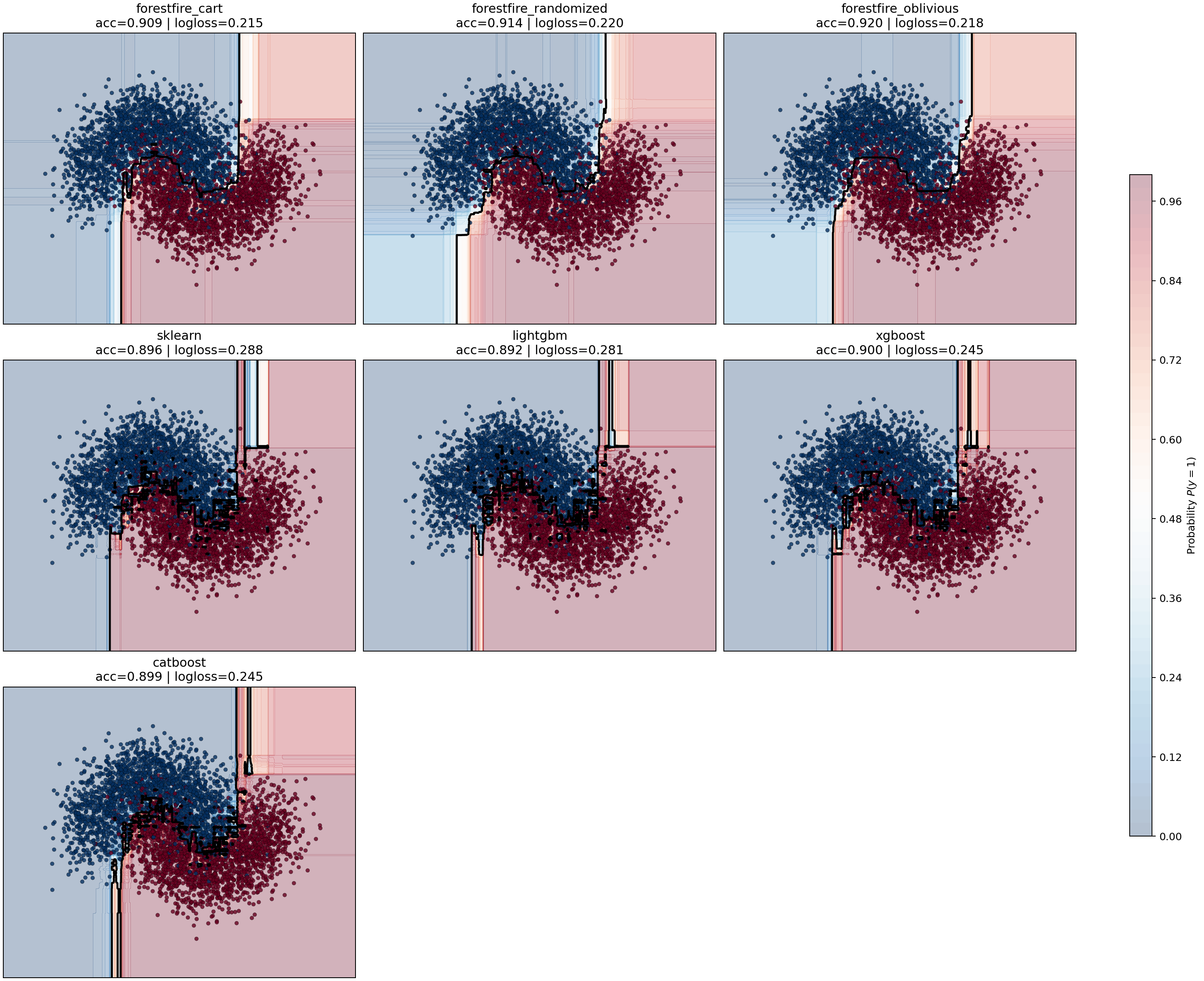
make_moons probability benchmark
The grid and micro-benchmarks answer runtime questions.
They do not show what kind of classifier boundary each model actually learns.
For that, the suite now includes a dedicated sklearn.datasets.make_moons
benchmark that focuses on a two-dimensional nonlinear classification problem
where a probability surface is visually informative.
The benchmark trains two ForestFire variants for each family:
- ForestFire CART
- ForestFire oblivious
and compares them against the closest ensemble implementations in the other libraries:
- scikit-learn
- LightGBM
- XGBoost
- CatBoost for gradient boosting
The purpose is different from the grid benchmarks:
- show how confidently each model partitions the two-moons manifold
- show whether the probability field is smooth, blocky, symmetric, or brittle
- make the CART-vs-oblivious tradeoff visible for ForestFire directly
The benchmark writes:
- per-family probability-surface figures
- per-family JSON results with train time, predict time, accuracy, and log loss
- per-family markdown summaries
Current plot outputs:
Regression curve benchmark
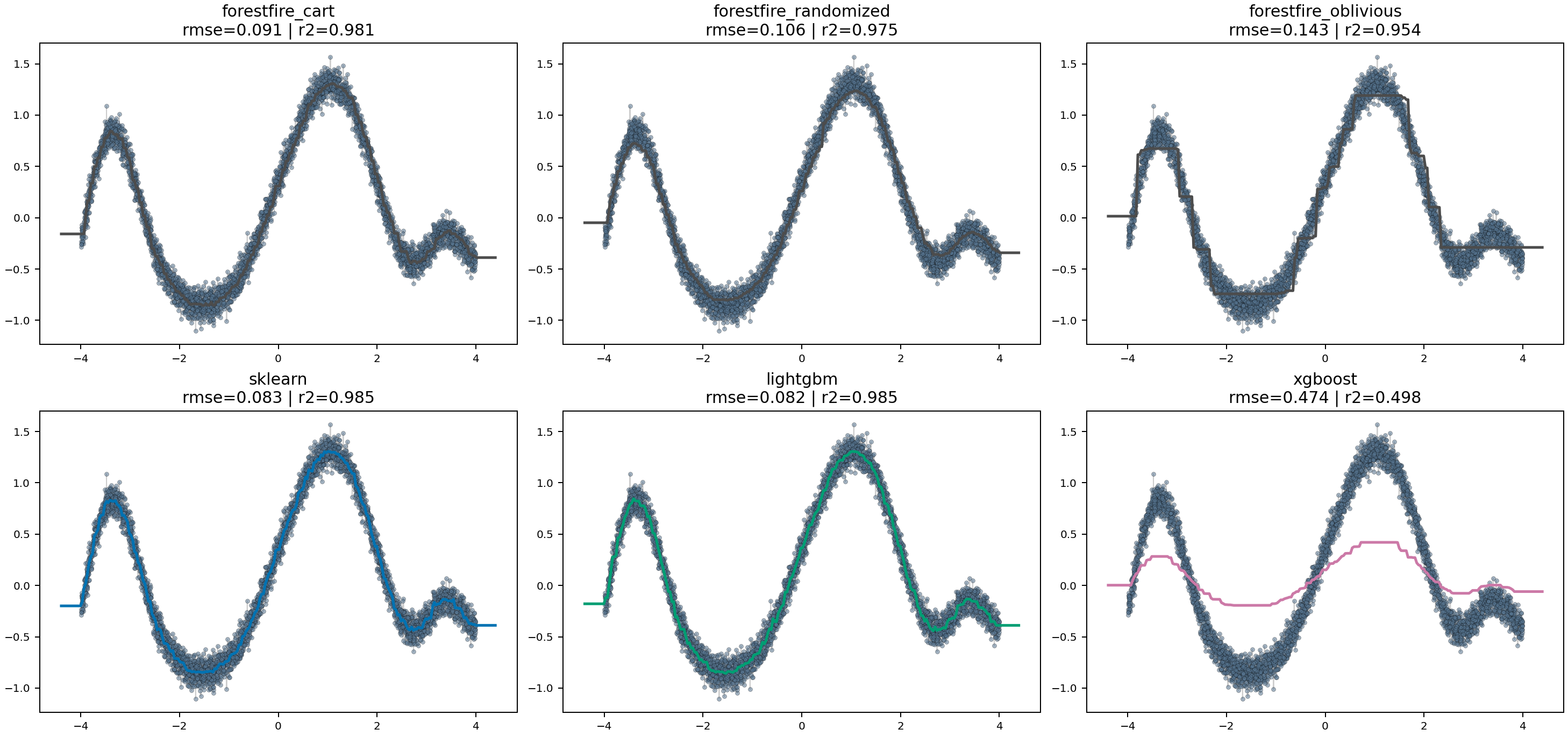
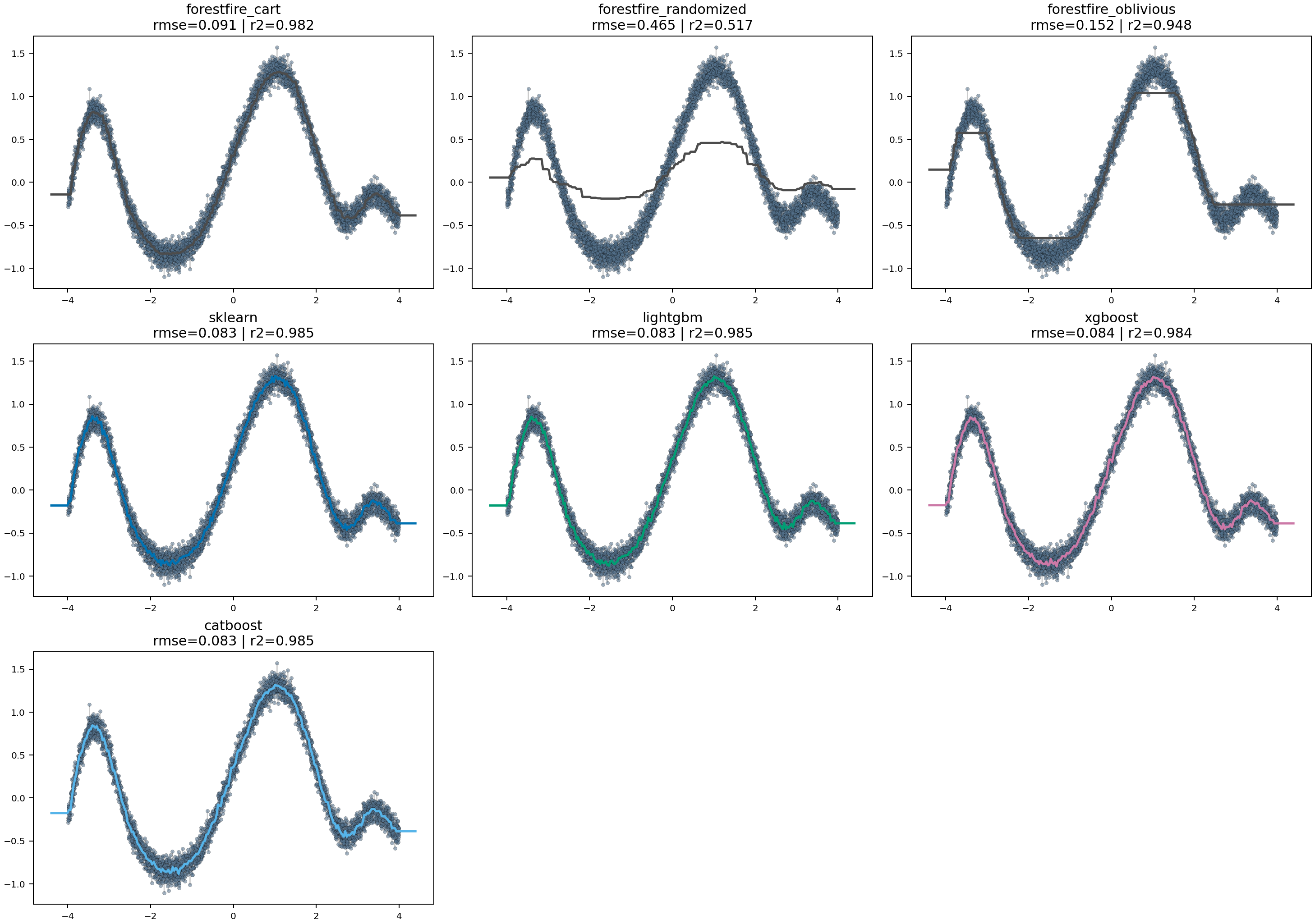
The runtime grids answer scaling questions, and make_moons answers a visual
classification question.
They still do not show how the regressors behave on a simple nonlinear function where smoothness, bias, and local overfitting are easy to inspect directly.
For that, the suite also includes a dedicated one-dimensional synthetic regression benchmark. It trains the supported random-forest and gradient-boosting regressors on a noisy nonlinear target, then plots each backend's prediction curve against the sampled training data.
This benchmark is useful for a different class of comparison:
- whether a model tracks the underlying shape smoothly or in blocky steps
- whether a backend overshoots or flattens in sparse regions
- whether ForestFire CART, randomized, and oblivious trees differ visibly in fit character
- whether the boosted variants introduce sharper local corrections than the forest variants
Like the make_moons benchmark, it writes one artifact set per ensemble family:
- a rendered prediction-curve figure
- a JSON results file with fit time, predict time, RMSE, and
R^2 - a markdown summary
Current plot outputs:
Complexity matching
To keep the cross-library comparisons more meaningful, each grid cell now uses ForestFire as the complexity reference.
The benchmark flow is:
- train the ForestFire model for that grid cell
- inspect every constituent tree
- take the largest realized leaf count
- use that leaf budget when configuring the comparable backends
That means the benchmark is no longer comparing models that merely share:
- the same nominal
n_estimators - the same nominal
max_depth
It also tries to align the realized per-tree complexity.
Just as important, the benchmark avoids adding a second independent tree-size cap on top of that leaf budget.
So the suite does not intentionally constrain tree size through:
max_depthmin_samples_splitmin_samples_leaf
except where a backend does not expose a true unlimited mode. In those cases the benchmark uses a large non-binding depth sentinel so the leaf budget remains the practical complexity control.
Why this matters:
- different libraries can interpret depth and split heuristics differently
- the same
max_depth=8does not guarantee the same realized tree size - without a leaf-budget alignment, some libraries may simply be training much larger trees than others
The exact mapping depends on backend capabilities:
- sklearn:
max_leaf_nodes - LightGBM:
num_leaves - XGBoost:
grow_policy="lossguide"withmax_leaves - CatBoost:
grow_policy="Lossguide"withmax_leaves
ForestFire itself is still timed independently after the reference fit for training benchmarks. The reference fit exists only to establish the complexity target for that grid cell.
That complexity-matching flow applies to training only.
Prediction is now decoupled from fitting in a simpler way:
- one fixed training dataset is chosen per feature-count cell
- each backend is trained once on that fixed dataset
- only inference calls are timed across the prediction row grid
- training cost is no longer paid inside the prediction timing loop
Tasks
task benchmark-training-rftask benchmark-training-gbmtask benchmark-prediction-rftask benchmark-prediction-gbmtask benchmark-training-micro-rftask benchmark-training-micro-gbmtask benchmark-prediction-micro-rftask benchmark-prediction-micro-gbmtask benchmark-moonstask benchmark-regression-surfacetask benchmark-microtask benchmark
The task split is:
task benchmark: cross-library end-to-end train/predict gridstask benchmark-micro: ForestFire-only phase breakdownstask benchmark-moons: two-dimensional probability-surface comparison onmake_moonstask benchmark-regression-surface: one-dimensional prediction-curve comparison on a synthetic regression task
Output artifacts
Benchmark artifacts are written under docs/benchmarks/.
For each family/problem pair, the scripts write:
training_grid_results_<family>_<problem>.jsonprediction_grid_results_<family>_<problem>.jsontraining_micro_results_<family>_<problem>.jsonprediction_micro_results_<family>_<problem>.jsontraining_grid_<family>_<problem>.pngprediction_grid_<family>_<problem>.pngtraining_micro_<family>_<problem>.pngprediction_micro_<family>_<problem>.pngtraining_summary_<family>_<problem>.mdprediction_summary_<family>_<problem>.mdtraining_micro_summary_<family>_<problem>.mdprediction_micro_summary_<family>_<problem>.mdmoons_results_<family>.jsonmoons_probabilities_<family>.pngmoons_summary_<family>.mdregression_curve_results_<family>.jsonregression_curve_<family>.pngregression_curve_summary_<family>.md
The summary markdown files are generated from the measured results and call out:
- which backend is fastest in the most grid cells
- median measured time by backend
- scaling from the smallest to the largest row count
- optimized-vs-base ForestFire speedups where applicable
For the micro-benchmarks, the generated summaries instead focus on:
- median time per ForestFire phase
- preprocessing share of end-to-end training
- optimized / compiled speedups over semantic prediction
- scaling from the smallest to the largest batch size
Artifacts are updated incrementally as the grid runs, so long benchmark executions still leave behind partial plots, JSON, and summaries instead of producing only all-or-nothing output.
How to read the plots
Each plot is a grid of feature-count subplots.
Inside each subplot:
- x-axis: row count
- y-axis: time
- one line per backend
Both axes are logarithmic.
That is deliberate:
- tree learners and runtimes often scale multiplicatively rather than additively
- log axes make slope comparisons more informative
What to pay attention to in the results
When you look at the generated plots and summaries, the important patterns are usually:
Random forest training
Watch how quickly time rises as both:
- rows increase
- feature count increases
RF training cost is especially sensitive to repeated split search, so this is the place where:
- histogram efficiency
- feature subsampling
- per-tree overhead
show up most clearly.
Because the suite now aligns the other libraries to ForestFire’s realized leaf budget, large remaining gaps are less likely to be explained by one backend simply building much bigger trees.
Gradient boosting training
Watch whether the backend spends more time per stage as the row count grows.
Boosting behaves differently from RF because it is:
- sequential across stages
- re-evaluating residual structure repeatedly
- more exposed to stage-wise stopping logic
For ForestFire specifically, GBM results are also shaped by:
- canary-based stage stopping
- second-order tree fitting
- gradient-focused row sampling
So if ForestFire’s GBM trains fewer effective stages than another backend on the same grid cell, that is often an intended consequence of the stopping strategy rather than just a raw implementation speed effect.
The leaf-budget matching helps here too, but it does not eliminate all policy differences. ForestFire’s canary-based stage stopping is still a genuinely different training rule from the early-growth behavior of the other libraries.
Prediction
Prediction is now a predict-only benchmark over a fixed set of already-fitted models.
As row counts grow, the interesting questions are:
- how early does optimized inference separate from the base model?
- does that gap widen as the row count grows?
- does the gap widen more for RF than for GBM?
- how do the non-ForestFire backends compare when their training cost is not part of the measurement?
That is a much cleaner direct measure of runtime prediction behavior, because the benchmark no longer hides inference behind per-cell training cost.
Interpreting backend differences
A few differences are structural, not accidental:
- LightGBM and XGBoost are heavily optimized around histogram-based boosting and large-scale batch workloads
- scikit-learn is usually a strong baseline for conventional RF behavior, but it is not built around the same runtime-lowering story
- CatBoost is most meaningful as a GBM comparison, not an RF comparison
- ForestFire’s RF and GBM behavior includes design choices other libraries do not share, especially: canaries for tree-growth and GBM-stage stopping, explicit optimized runtime lowering, and unified binning semantics shared across training, serialization, and inference
That warning matters most for training.
For prediction, the main interpretation question is now:
- how much faster is each backend at pure inference once model fitting has been paid for already?
Documentation and generated summaries
This page explains what the benchmark suite is designed to show.
The result-specific commentary should come from the generated summary files after you run the benchmarks locally, because those summaries reflect the actual measured grid rather than a hand-written expectation.
Once the benchmarks are run, the most useful files to inspect alongside the plots are:
training_summary_random_forest_classification.mdtraining_summary_random_forest_regression.mdtraining_summary_gradient_boosting_classification.mdtraining_summary_gradient_boosting_regression.mdprediction_summary_random_forest_classification.mdprediction_summary_random_forest_regression.mdprediction_summary_gradient_boosting_classification.mdprediction_summary_gradient_boosting_regression.md